
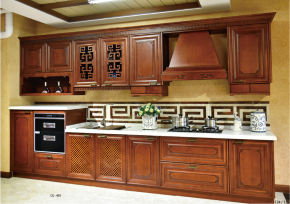
The ancients called it “Stone symbolizes steadfastness, while wood embodies warmth and gentleness.” In traditional Chinese culture, wood is a natural material intimately connected with humanity—qualities that are most vividly expressed in solid‑wood furniture. Through the changing seasons, its timeless charm endures. The beauty of solid‑wood furniture is, above all, a natural art form refined by the passage of time. Skilled artisans infuse their deep understanding of wood into every meticulous stroke of their craft, weaving it seamlessly into the grain, ensuring that each piece remains fresh and enduring. So, how should we go about selecting solid‑wood furniture?
To assess the material of solid‑wood furniture, examine the wood grain and knots. Check the grain: for example, if the front of a cabinet door displays a particular pattern, look at the corresponding pattern on the back; if the two match closely, it confirms that the door is made of solid wood. Inspect the knots: identify the location of any visible scars or blemishes, then check the opposite side for matching patterns. To evaluate quality, observe whether the wood is dry and evenly white, with a dense, fine texture. If the piece incorporates materials such as particleboard, MDF, or molded panels, open the doors or drawers and sniff to see if there’s any pungent odor.
Stability and Safety: To ensure wooden furniture is both safe and stable, first check for issues such as drawer misalignment or door frame warping. Also look for signs of poor craftsmanship, like skewed mortise‑and‑tenon joints, oversized holes, or loose, ill‑fitting tenons. Next, open both cabinet doors. 90 After installation, gently pull the cabinet forward by hand; the cabinet should not tip forward on its own. The glass used in bookcase doors must be edge‑ground. For full-length mirrors and dressing tables, a back panel must be installed, and trim strips should securely hold the glass in place.
When inspecting wooden furniture, ensure the structure is solid and the frame shows no looseness; broken tenons or split material are unacceptable. All components made from engineered wood should have edge banding. Fasteners must be fully installed—no missing parts, loose nails, or protruding nails—and mortise-and-tenon joints without visible nails are considered superior. To test panel strength, press firmly on the surface; a sturdy panel will feel firm and stable. Panels with an internal lattice‑like framework provide added rigidity; if the framework is sparse, pressing the surface will reveal a hollow, unstable feel and significant vibration. Also press the drawer bottom to assess its strength; partition bottoms are typically made of laminated boards, while larger partitions should use five‑layer plywood. Cabinet doors and drawers must open and close smoothly. When veneer or other materials cover the panel, their color should match the rest of the set. The finish must be free of wrinkles, stickiness, or paint defects. For a thorough surface inspection, run your hand over the furniture, carefully checking that the polished surfaces are smooth. Pay particular attention to areas like raised edges, ensuring they are not rough; look for streaks in the paint, verify that corner coatings are not overly thick, and check for cracks or bubbles.